
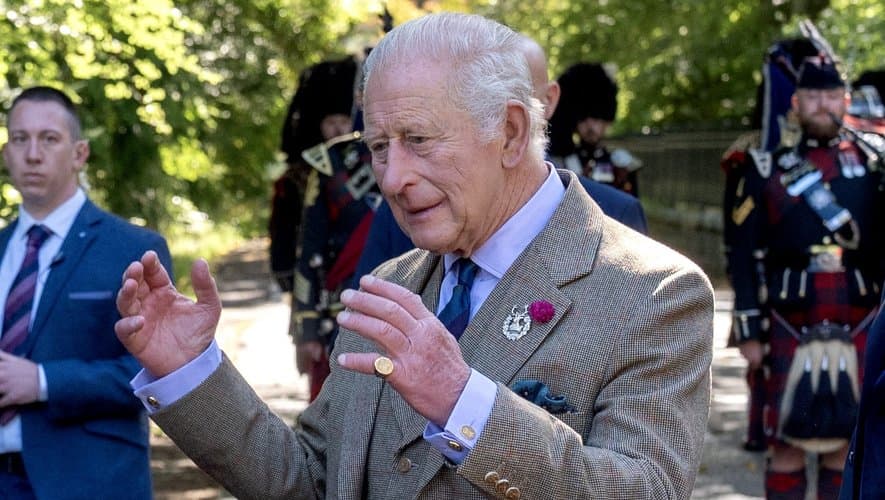
Two and a half years have passed since Buckingham Palace revealed, in February 2024, that King Charles III had cancer. Since that announcement, which sparked a wave of emotion in the United Kingdom and well beyond, the exact nature of the British sovereign's illness has never been specified, and it likely never will be. According to La Depeche, this opacity is deliberately maintained by the palace, which has made the king's state of health one of the most tightly guarded subjects of the British monarchy.
This choice of silence is nothing new in the history of the royal family. Unlike other heads of state or public figures whose health is the subject of detailed medical bulletins, the British monarchy has always cultivated a form of institutional modesty around the sovereign's body. This tradition, which goes back several generations, aims to preserve both the dignity of the royal function and a form of symbolic stability in the eyes of public opinion, in a country where the monarch embodies continuity above individual vicissitudes.
The sparse information released by Buckingham Palace over the past eighteen months nonetheless points in a rather encouraging direction. According to details reported by La Depeche, Charles III's state of health is said to have improved over the months, to the point that his treatment was reportedly reduced. This positive development would partly explain the gradual resumption of his public engagements, with the king stepping up official appearances, trips abroad and ceremonial duties despite the illness.
That said, no details have emerged about the type of cancer the monarch has, nor about the stage at which it was diagnosed at the time of the initial announcement. The palace had at the time simply stated that the illness had been detected during a separate surgical procedure, related to a benign enlargement of the prostate, without ever confirming that the cancer concerned that organ. This deliberate ambiguity, maintained ever since, has fuelled speculation in the British and international press for two and a half years.
La Depeche points out that this question has become, in its own words, "the world's best-kept secret". A phrase that reflects the scale of the confidentiality arrangements put in place around the king's medical file, in a context where the British monarchy nonetheless remains one of the most closely watched institutions on the planet, with an extremely active royal and celebrity press in the United Kingdom.
This withholding of information is also part of a broader calculation of institutional communication. By never revealing the precise nature of the cancer, Buckingham Palace avoids feeding interpretations about the real severity of the illness, its prognosis, or the king's ability to continue carrying out his duties over the long term. This strategy of vagueness also allows the palace to control the media narrative, releasing only general and reassuring information, such as that of a reduced treatment, without ever giving outside medical experts material for more in-depth analysis.
The context in which Charles III operates also remains a particular one. Having acceded to the throne in September 2022 upon the death of his mother, Elizabeth II, after decades spent as heir apparent, the king had barely begun his reign when the announcement of his cancer came, in February 2024. This illness immediately revived questions about the succession and about the growing role of Prince William, now Prince of Wales, in the institutional life of the kingdom.
Despite the illness, Charles III has never fully suspended his duties. He has continued to hold a certain number of audiences, diplomatic meetings and official ceremonies, while reducing his schedule compared with what it was before the diagnosis. This ability to maintain a public presence, even a reduced one, has been interpreted by several royal observers as a sign that the illness, while not trivial, remained a priori compatible with the continuation of his reign.
The reduction in treatment mentioned by La Depeche is, in this respect, a further indication of a favourable development, without however allowing definitive conclusions to be drawn about the sovereign's real state of health. In the highly codified world of royal communication, every word chosen by the palace is carefully weighed, and the absence of alarming statements is generally interpreted as a positive signal, though no certainty can be established for lack of precise medical data.
This situation more broadly illustrates the permanent tension between the need for transparency expressed by part of public opinion and the media, and the right to privacy claimed by the royal family on subjects as sensitive as health. A balance that Buckingham Palace has been striving to preserve since February 2024, releasing just enough information to reassure without ever lifting the veil on the essential.
At this stage, nothing indicates that this communication strategy is likely to change in the months ahead. The palace will likely continue to communicate in successive snippets about the general evolution of the king's health, without ever revealing the precise nature of his cancer, thereby perpetuating a tradition of discretion characteristic of the British monarchy in the face of its sovereigns' personal ordeals.