
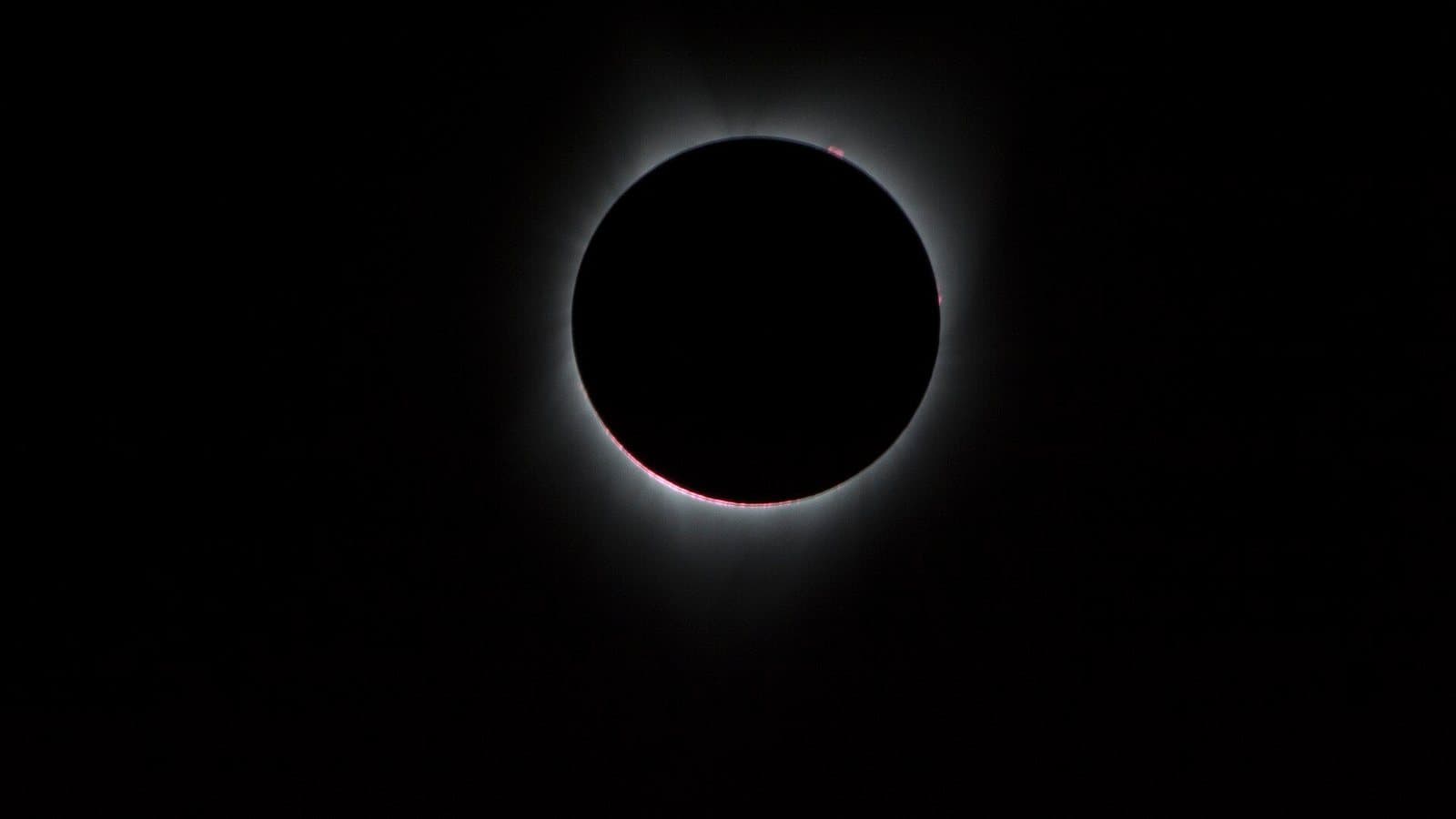
On Wednesday 12 August the moon will cover most of the sun over France. The last comparable event was on 11 August 1999. The next total eclipse visible from mainland France is on 3 September 2081. That gap of eighty-two years looks like bad luck and is in fact a straightforward consequence of geometry.
Solar eclipses are not rare. They happen somewhere on Earth two to five times a year, and there are 224 of them across the 21st century. They are also predictable a long way ahead, because they repeat on the Saros cycle of 18 years, 11 days and 8 hours, after which a similar eclipse recurs with a shift in where it can be seen.
The scarcity is entirely about where the shadow falls. The moon's umbra sweeps a band across the Earth that is at most around 160 kilometres wide, and often much narrower. Against a planet with a circumference of 40,000 kilometres, that track covers a vanishingly small fraction of the surface on each pass. According to the Association Francaise d'Astronomie, the odds work out such that any given place waits roughly 400 years between total eclipses. Eighty-two years is not a long wait by that standard. It is a short one.
Wednesday's eclipse is total over Greenland, Iceland and Spain. Over mainland France it is partial, though only just in places. Obscuration passes 95 percent across large parts of the country and reaches 99.5 percent at Biarritz, which is close enough to totality to be memorable and, technically, is not totality at all. The 2081 event, according to the Observatoire de Paris, will run from 89.8 percent at Strasbourg to 99.6 percent at Hendaye.
If waiting until 2081 is unappealing, the answer is a plane ticket rather than patience. The next total eclipse is on 2 August 2027, over the southern tip of Spain around Tarifa and Cadiz, which is a drive from the French border. Another follows on 22 July 2028 across Australia and New Zealand, with Sydney inside the track. Eclipse chasing exists as a hobby for exactly this reason: the events are frequent, and it is only the observer who has to move.
Never look directly at the sun without certified eclipse glasses or an approved solar filter, including during a deep partial phase. Ordinary sunglasses, exposed film and smoked glass do not protect the eye, and looking through binoculars, a camera or a telescope without a proper solar filter can cause permanent damage in seconds.