
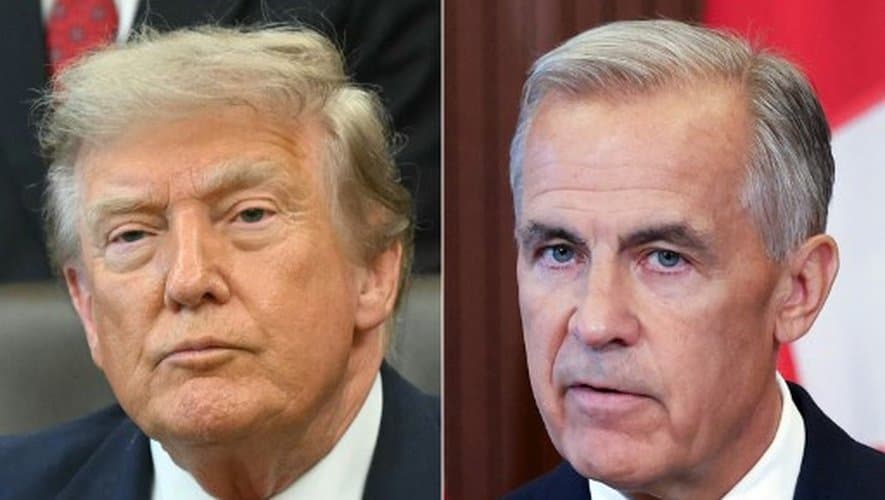
The trade tension between Washington and Ottawa reached a new level this week. According to La Depeche, US President Donald Trump publicly voiced his irritation at the retaliatory tariffs announced by Canadian Prime Minister Mark Carney, believing these measures went too far. The tone used by the occupant of the White House, who reportedly issued a sharp "that's enough," illustrates just how much the North American trade dossier has soured in recent months.
This latest clash is part of a cycle of retaliation that has been going on for several months between the two North American neighbors, historically linked by economic exchanges considered among the most significant in the world. Washington struck first with a series of surtaxes targeting several key sectors of the Canadian economy, provoking the ire of Ottawa, which had promised not to sit idly by.
Mark Carney, who came to power amid high economic expectations, has chosen firmness over appeasement. By announcing new tariffs in response to the American surtaxes, the Canadian Prime Minister is sending a clear signal to his public opinion and his trading partners: Canada does not intend to let its economic policy be dictated by its southern neighbor, even if it means paying a price diplomatically.
On the American side, this Canadian response is seen as a further provocation in a context where Donald Trump has multiplied protectionist measures since his return to the White House. The American president has made the revision of trade agreements and the reduction of trade deficits one of the pillars of his economic policy, even at the cost of straining historically stable diplomatic relations with traditional allies such as Canada.
This tariff escalation is not without concrete consequences for businesses in both countries. The manufacturing, agricultural, and energy sectors, which are particularly interconnected between the United States and Canada, find themselves on the front line. Manufacturers on both sides of the border fear rising production costs and a loss of competitiveness, in a global economic context already marked by uncertainty.
Economic analysts are closely following the development of this standoff, which could have repercussions well beyond the bilateral framework alone. The Canada-United States-Mexico Agreement, which normally governs North American trade, finds itself weakened by this succession of unilateral measures, reviving questions about the solidity of the multilateral framework meant to guarantee a degree of predictability for economic actors.
For Mark Carney, a former central banker recognized for his cautious management of economic crises, this choice of confrontation represents a political gamble. By betting on firmness toward Washington, he seeks to consolidate his image as a leader capable of defending Canadian economic interests, in a country where nationalist sentiment in the face of American pressure has clearly grown in recent months.
Donald Trump, for his part, is pursuing a line he has maintained for several years: using tariffs as a bargaining lever, even if it strains relations with historic partners. His displayed impatience with the Canadian measures could foreshadow new American announcements in the coming days, in a logic of escalation that worries economic circles in both countries.
This new escalation also comes at a sensitive time domestically for both leaders. In the United States, the Trump administration must contend with criticism over the inflationary impact of its tariff policy, while in Canada, Mark Carney must demonstrate his ability to protect the national economy without provoking a lasting rupture with the country's main trading partner.
The coming weeks look set to be decisive for the future of this trade relationship. While no sign of de-escalation has been observed for the moment, several observers believe bilateral negotiations could open once the current phase of political one-upmanship subsides, given how considerable the crossed economic interests between the two countries remain.
In the meantime, businesses and consumers on both sides of the border are bracing for the consequences of this standoff, which, according to several experts cited by the economic press, is a reminder that North American trade tensions are far from resolved and could still intensify before easing.