
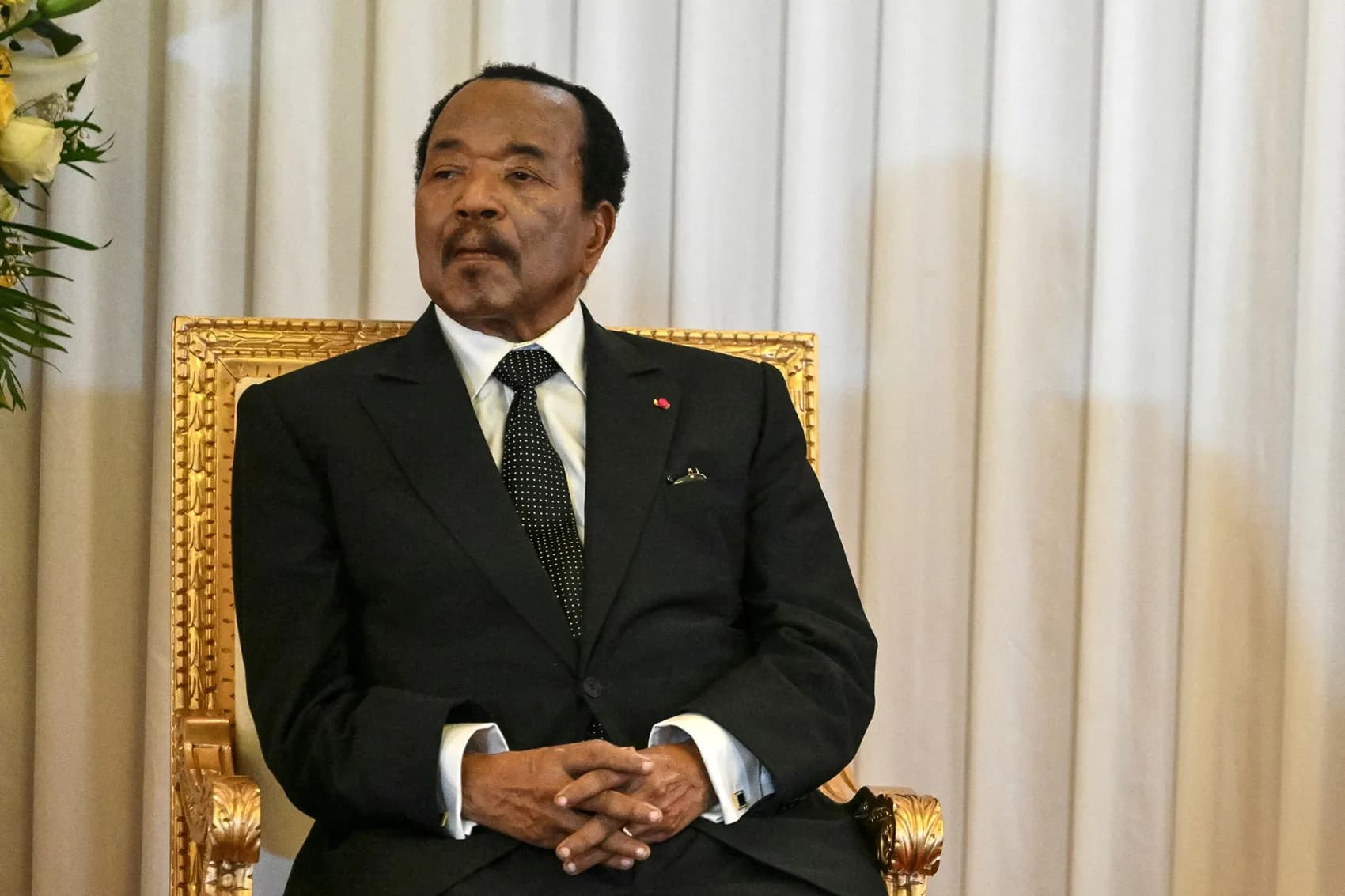
Cameroon's 93-year-old president, Paul Biya, has returned home after an extended absence of more than two months, according to France24 English, which reported that the veteran leader had been staying in Geneva alongside family members and a small circle of aides. His arrival back in Yaounde on Thursday closes a chapter of uncertainty that had gripped the Central African nation, where speculation about the health and whereabouts of its long-serving head of state has become a recurring feature of political life.
Biya, who has led Cameroon since 1982, is the world's oldest sitting head of state and one of Africa's longest-ruling presidents. His decades in office have coincided with periods of relative stability in parts of the country alongside persistent unrest in others, including a protracted conflict in the Anglophone regions and ongoing security challenges linked to Boko Haram in the north. Throughout his tenure, Biya has cultivated a governing style that relies heavily on a tight inner circle, and his periodic trips to Europe, often to Switzerland, have long fueled public curiosity given the limited information released by his office about the purpose and duration of such visits.
This latest 73-day stay abroad, as detailed by France24 English, was notable both for its length and for the silence that surrounded it. Cameroonian officials offered little in the way of public explanation while Biya remained overseas, a pattern that has become familiar to citizens accustomed to opaque communication from the presidency on matters concerning the leader's personal schedule and condition.
The extended absence did not go unchallenged domestically. Opposition figures seized on the gap to question how the country was being governed in the president's physical absence, with critics accusing the administration of effectively running the state on what France24 English described as "autopilot." Such characterizations reflect broader anxieties among Biya's political opponents and segments of civil society about the concentration of decision-making power within a small, aging leadership structure, and about the absence of clear constitutional mechanisms or public reporting when the president is out of the country for such a long stretch.
Cameroon's constitution grants the presidency sweeping authority, and Biya has consistently resisted pressure to decentralize power or to groom a visible successor, a stance that has intensified speculation about what would happen should he become incapacitated or unable to fulfill his duties. Analysts who follow Central African politics have long pointed to this uncertainty as one of the central vulnerabilities facing Cameroon, a country of some 28 million people that plays a significant economic and strategic role in the Central African subregion.
Biya's return comes against the backdrop of a political landscape that remains highly sensitive to any signal about his capacity to continue leading the country. He was declared the winner of a disputed presidential election in October 2025, a vote that triggered demonstrations and drew criticism from opposition parties who alleged irregularities. That contested victory extended his rule and set the stage for what many observers expect to be his final term, intensifying scrutiny of his health and day-to-day engagement with governance.
The president's advanced age has made his physical condition a matter of persistent national and international interest. Public appearances by Biya are typically brief and tightly controlled, offering few opportunities for independent assessment of his health, and this has historically amplified rumors whenever he departs for medical checkups or private visits abroad. His government has in the past dismissed such rumors as baseless, though it rarely provides detailed rebuttals or documentation to definitively settle the speculation.
For ordinary Cameroonians, the president's prolonged absence and subsequent return underscore deeper frustrations with a political system many view as unresponsive to public accountability. Economic challenges, including youth unemployment and regional disparities in development, continue to weigh on the population, and critics argue that a government preoccupied with managing the optics of its leader's health is less equipped to address these pressing domestic priorities.
Regional and international observers will likely watch closely to see whether Biya's return signals a resumption of more active engagement in state affairs or whether it is largely symbolic, given the extent to which day-to-day governance may already rest with senior officials and advisers around him. Any indications of diminished capacity could reignite debate both within Cameroon and among its international partners about succession planning and the stability of the country's political institutions.
As Biya resumes his duties in Yaounde, the episode adds to a broader pattern that has defined much of his later presidency: recurring uncertainty over his health and travel, met with limited transparency from his government, and an opposition eager to use such moments to press its case that Cameroon's leadership needs renewal. Whether this latest return will quiet those concerns or simply set the stage for the next round of speculation remains to be seen.