
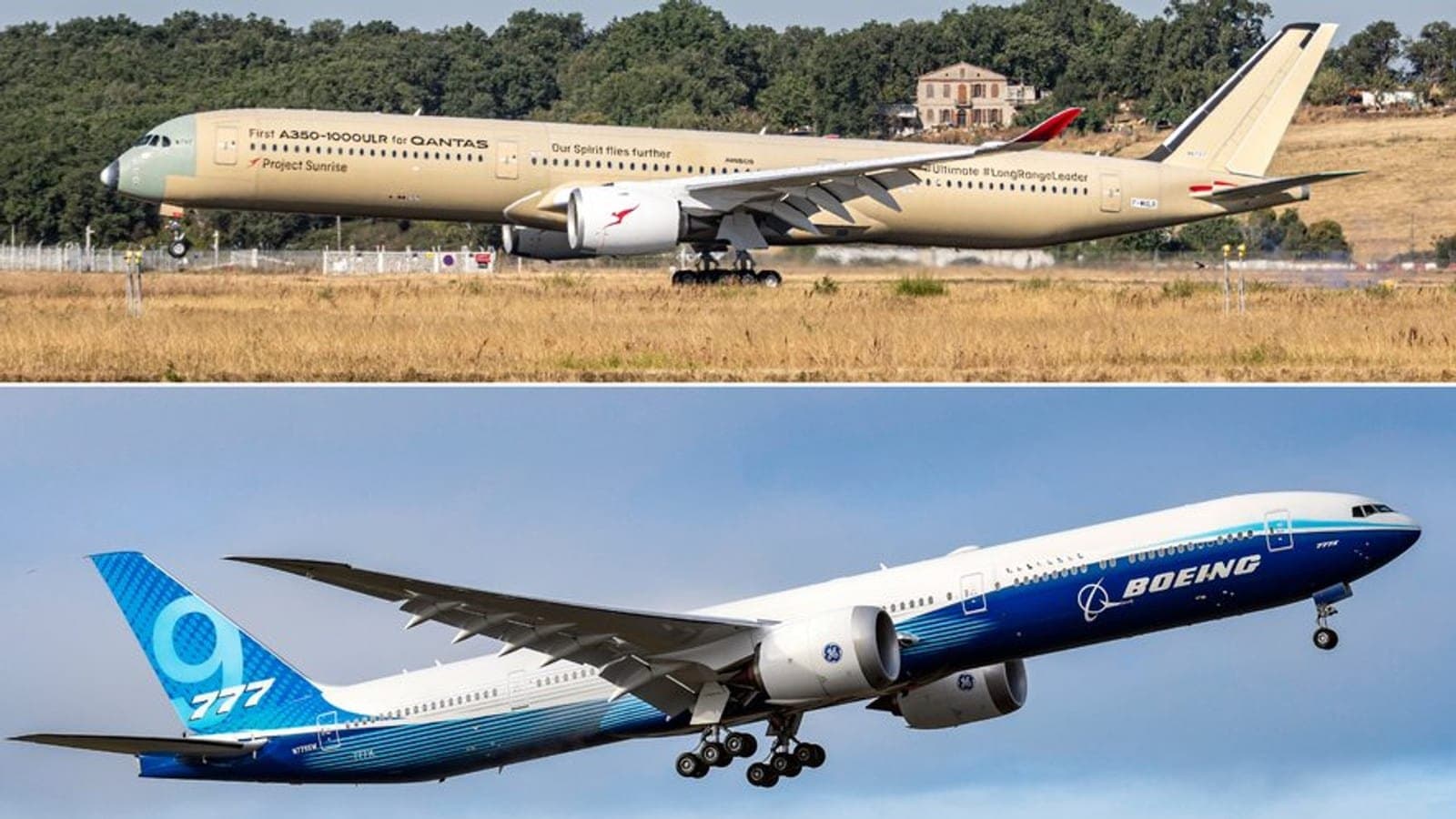
Two widebodies enter service next year, the A350-1000ULR from Airbus and the 777X from Boeing, and they are routinely described as going head to head. They both promise 20 to 25 percent lower carbon emissions than the generation they replace. Beyond that they answer opposite questions, and the order books show it more clearly than any specification sheet.
Airbus has taken range to its limit. The ULR carries an additional 20,900 litres of fuel in the centre wing box, which lifts its reach from 16,500 kilometres to close to 18,000 and lets Qantas fly non-stop for more than twenty hours, Sydney to London or Sydney to New York. The cabin is fitted for 238 passengers across four classes, against roughly 400 in a standard A350-1000, with a wellbeing area at the rear open to everyone, a self-service bar and space to stretch.
Boeing has taken capacity and engineering. The 777X comes in three variants and seats 425 to 450 in two classes, with range between 14,800 and 17,500 kilometres. It carries GE9X engines 3.40 metres across, the largest ever fitted to an airliner, and folding wingtips: 72 metres of span in flight for lift and fuel burn, folded to 65 metres on the ground so the aircraft fits the stands and taxiways airports already have.
The commercial gap is the part worth sitting with. The ULR has twelve firm orders, all from Qantas. The 777X has more than 1,100. That is not a verdict on which aircraft is better built. It is a description of two different products. One is a halo variant for a single airline solving a single geographic problem, the distance from Australia to Europe and the American east coast. The other is the replacement for the 777-300ER, an aircraft type flying in fleets all over the world that has to be replaced by something.
The economics explain the asymmetry. Fuel burn per seat is what makes a long-haul route work, and the ULR is carrying 238 passengers and a very large quantity of fuel over a distance where a meaningful share of that fuel exists to carry the rest of the fuel. On a route nobody else can fly, a premium fare covers it. On a route that can be flown with one stop, it does not. That is the whole reason the order book is twelve and not two hundred, and why Airbus can still be right that others will follow: the list of city pairs that need eighteen thousand kilometres is short, but it is not empty.
The 777X carries a different lesson. The programme ran seven years late, which in most industries would have killed it, and airlines kept their orders anyway. There is no third supplier at this size. A carrier that needs 400 seats on a long sector can wait for Boeing or buy from Airbus, and Airbus does not currently build anything that seats 450. Delay is survivable in a duopoly in a way it is nowhere else.
For Toulouse the practical point is that neither aircraft displaces the other. The A350 family has passed 1,600 firm orders across its variants, the 777X has 1,100, and the two of them are dividing the long-haul market by mission rather than taking share from each other. The competition everyone is expecting next year is real, and it will mostly be fought on the 350 to 400 seat overlap in the middle, not at the extremes where each of these aircraft was actually designed to sit.