
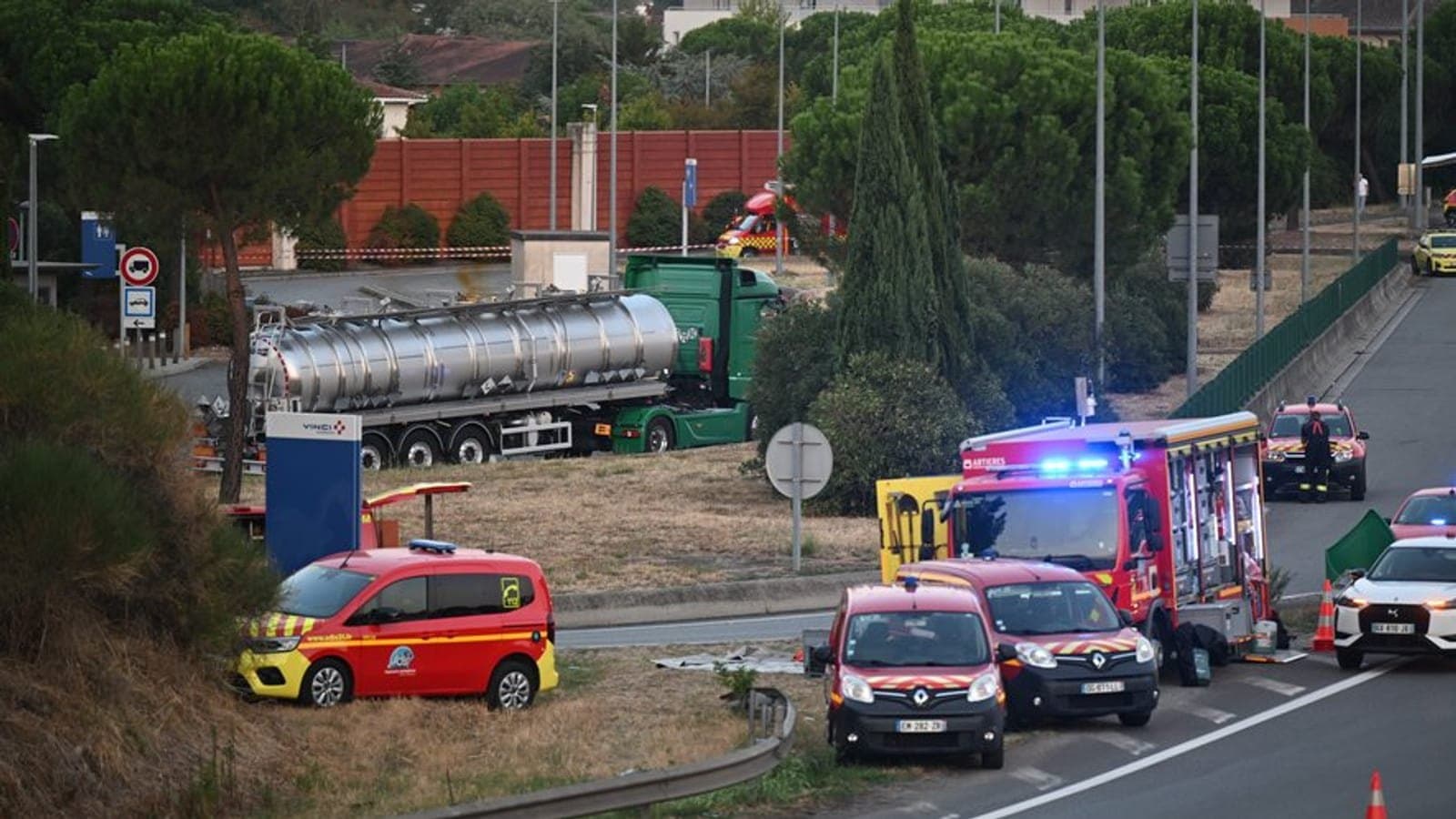
A heavy goods vehicle carrying dangerous goods began releasing potentially toxic fumes at the Toulouse Nord toll plaza at around 5pm on Thursday 13 August. The authorities ordered everyone within 500 metres to shelter indoors, five nearby streets were placed under that instruction, and the Haute-Garonne prefecture activated its departmental operations centre to run the response.
The lorry is stationary in the toll car park just past the northern barrier heading towards Montauban, where the site security post also stands. The leaking substance has been described to La Depeche as a corrosive liquid of the acid type, and a full assessment of the toxic risk was still being carried out by specialist teams. A witness described a yellow cloud escaping from the vehicle. Gendarmes are holding the cordon, the outside lane of the motorway has been closed, and around a dozen fire service vehicles are on scene.
Shelter in place is the correct instruction here and it is worth explaining, because the instinct in an emergency is to leave. With a dense corrosive vapour at ground level, a closed building with its ventilation shut is a better filter than the open air, and people moving through the plume on foot or in a car with the fan running are the most likely casualties. The order is not a precaution against panic. It is the actual protective measure, and it works only while people follow it.
The location is the other half of the problem. A toll plaza concentrates vehicles into a narrow space with buildings and homes close by, which is why five streets fall inside a 500 metre radius. It is also, for the emergency services, close to ideal: the lorry is stationary, the site has its own security post, and the motorway can be narrowed rather than closed. Had the same leak developed at speed on the open carriageway, the affected area would have been a line rather than a circle.
France moves a very large volume of hazardous material by road, under the international ADR rules that govern packaging, labelling, driver training and the orange plates that let responders identify a load before they approach it. Incidents of this kind are uncommon relative to that volume, and the system is built on the assumption that when one happens the substance can be identified quickly. That identification is what the specialist teams were still completing on Thursday evening.
The prefecture said updates would be issued through its official social media channels, which is where residents inside the perimeter should be looking rather than at accounts relaying the yellow cloud. Anyone in the affected streets should stay indoors, close windows and shut off ventilation until the prefecture lifts the instruction.