
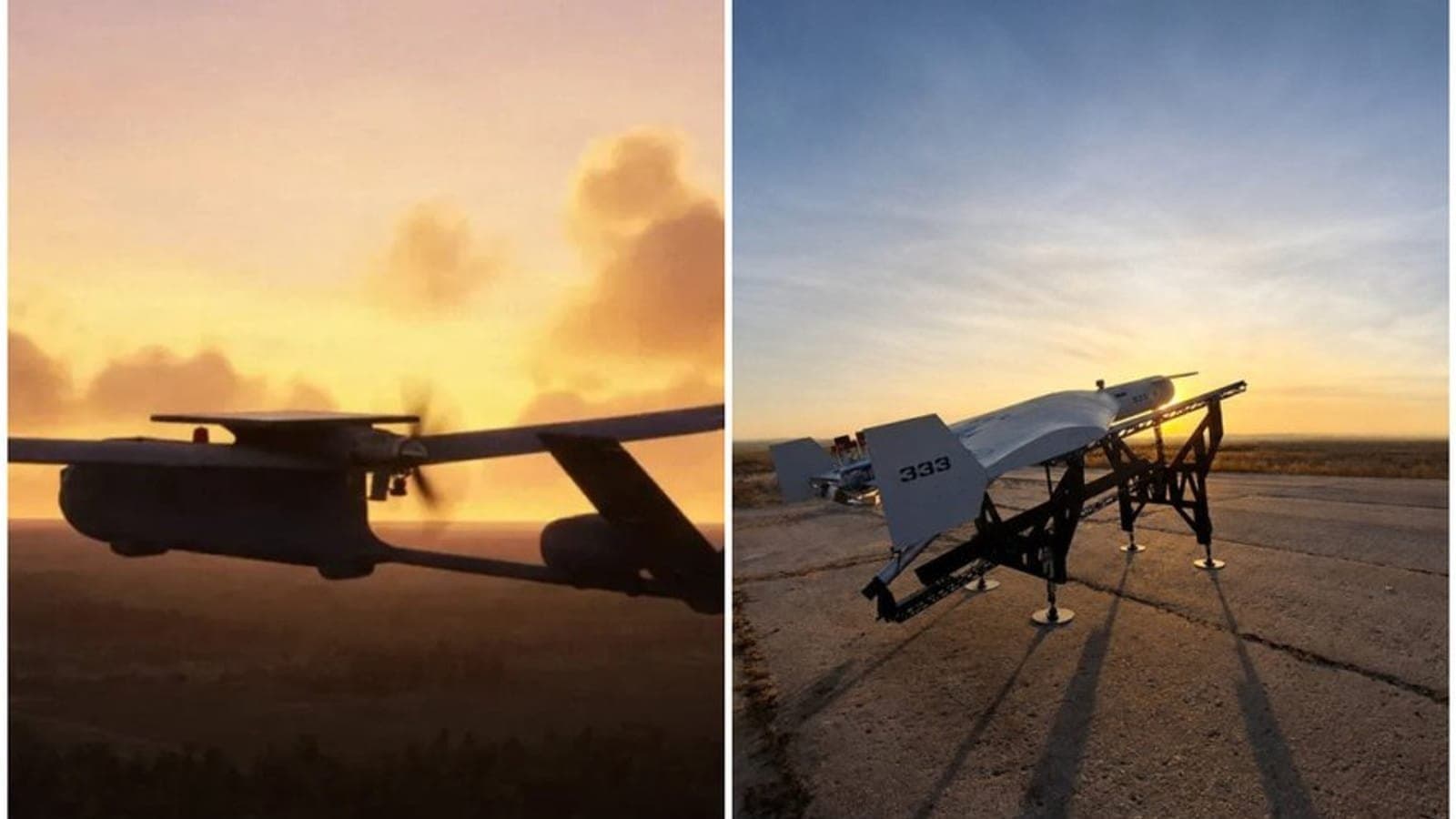
Ukraine has publicly presented a new long-range strike drone, the Dovbush T40, announced on 17 August. It is an unmanned aircraft of about five metres in wingspan with an endurance of more than 24 hours and a range beyond 2,000 kilometres, which puts targets past the Urals and into western Siberia within reach. It is described as multi-role: deep reconnaissance, artillery correction and precision strikes against infrastructure, equipment and personnel. In trials it is reported to have shown a low radar signature and good resistance to electronic warfare, the two properties that determine whether an aircraft of this kind arrives.
It joins the MICH 2000, whose existence stayed secret until 12 August. Derived from a Chinese civil drone design, it carries up to 60 kilograms of explosive over a comparable 2,000 kilometres, and in silhouette it closely resembles the Iranian Shahed. It has been operated since 2024 by Alpha, the special unit of the Ukrainian security service. According to the Ukrainian defence outlet Oboronka, thousands have been launched and hundreds of targets hit, including a strike on an airfield in which a Russian Tu-95 strategic bomber is said to have been destroyed.
The number that explains the strategy is the unit price. The MICH 2000 is reported to start at around 41,000 euros, with production at roughly 6,000 a year and an ambition of 10,000. Set that against what it is aimed at. A strategic bomber costs orders of magnitude more than the drone that reaches it, and so does the air defence interceptor fired to stop it. An adversary that must spend a million to defeat a forty-thousand-euro aircraft loses the exchange even when it wins the engagement, and it must win every time.
This is the logic that has reshaped the war. Ukraine cannot match Russia in ballistic missiles, which are expensive, and has instead built something it can produce in volume from commercial components. Range substitutes for precision at the strategic level: a weapon that can reach an airbase in Siberia forces dispersal, hardening and air defence coverage across a landmass, and imposing that cost is itself the objective whether or not any individual aircraft arrives.
Two cautions on the figures. They come from Ukrainian official announcements and a Ukrainian defence publication, in a war where both sides publicise capability partly to shape the other's planning, and specifications given at unveiling are claims rather than verified performance. The Tu-95 loss in particular is a claim attributed to Oboronka and has not been independently confirmed here.
For European defence ministries the interesting part is not the aircraft but the production model. Ukraine is manufacturing thousands of deep-strike systems a year at a unit cost below that of a family car, using an industrial base assembled under bombardment. European procurement is built around small numbers of expensive, exquisite platforms with decade-long timelines. Whichever model the next war rewards, only one of them is being tested right now.